Investment Nonlinearity in Smets–Wouters: A Switching-Fidelity Approach
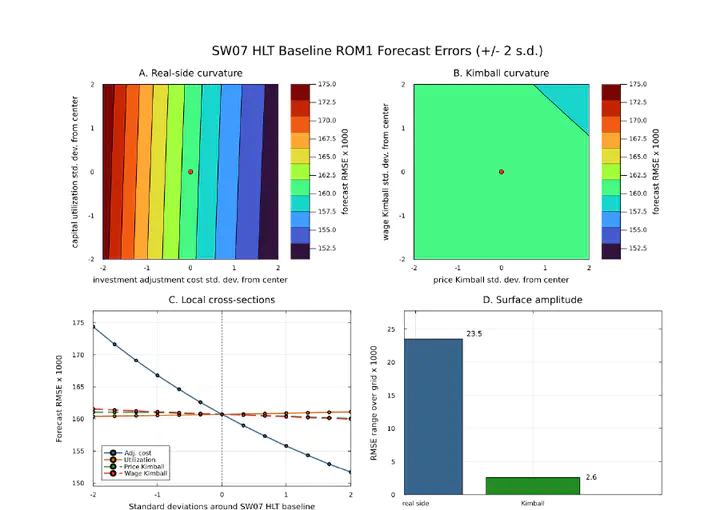 Real-side and price-setting curvature around the maintained Smets-Wouters calibration
Abstract
Where do nonlinear dynamics matter in a medium-scale model? I compare the nonlinear Harding-Lindé-Trabandt version of Smets-Wouters with its first-order approximation at the same parameters, states, and shocks. Direct stochastic extended-path solutions show that investment accounts for 78 percent of the squared gap across observables in model units and 66 percent after scaling each series by its nonlinear variation. Parameter ablations trace the gap to investment adjustment and capital utilization; price-setting nonlinearity matters only under extreme calibrations. In a common investment-shock experiment, higher-order local solutions close at most 16 percent of the nonlinear path gap. Switching-fidelity estimation makes the direct comparison practical: a supervised neural network learns the nonlinear-minus-linear gap and reduces raw pooled transition error by 43 percent on parameter-held-out validation paths. The method makes approximation error and failed nonlinear solves visible, but it audits one local solution branch rather than proving global uniqueness.